

Oversized ID Cards: A Practical Guide to Large-Format Credentials for Events
When most people hear “ID card,” they picture the familiar CR80 card—the same basic size as a credit card.
But not every credential needs to fit in a wallet.
For many organizations, a larger credential is easier to see, easier to identify from a distance, easier to attach to a lanyard, and much more practical for the way people actually use it. That is where oversized ID cards and credentials come in.
Oversized credentials are used across a surprisingly wide range of industries and applications. They are common at large events, healthcare facilities, schools and universities, construction sites, manufacturing facilities, hospitality properties, security operations, conferences, temporary work sites, and many other environments where a credential needs to be highly visible.
At IDSuperShop, one of the most commonly requested oversized formats is the 3.5″ × 5.5″ oversized credential. This size has become something of a universal format because it provides substantially more room than a standard ID card without becoming unnecessarily large or cumbersome.
And while blank oversized cards are available, many organizations actually need something different: custom preprinted credentials with their artwork, branding, security information, or credential categories already printed, followed by personalization or issuance at the facility.
This guide explains the options and, more importantly, why oversized credentials make sense for so many applications.
What Is an Oversized ID Card?
An oversized ID card is simply a credential that is larger than the standard CR80 card format used for most employee and access-control badges.
A standard CR80 card is approximately:
- 2.125″ × 3.375″
- Approximately 30 mil thick when produced as a conventional PVC card
- Designed primarily for wallets, badge holders, card readers, and traditional access-control applications
An oversized credential provides considerably more physical space for information.
The most common general-purpose oversized format we see is approximately:
3.5″ × 5.5″
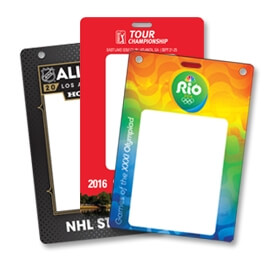
That gives organizations enough room for large photographs, names, job titles, departments, credential categories, event information, logos, color coding, instructions, sponsor information, QR codes, barcodes, or other visual information that would be difficult to fit comfortably onto a standard ID card.
Our 3.5″ × 5.5″ oversized PVC cards are approximately 30 mil thick and are available as blank cards for compatible inkjet card printers. The standard version is supplied without a slot or hole, making it appropriate for applications where the credential will be used with a badge holder or another attachment method.
View the 3.5″ × 5.5″ Oversized PVC Cards at IDSuperShop
However, that is only one configuration.
In practice, organizations often come to us with very specific requirements for how their oversized credential needs to be printed, attached, displayed, and used.
Why Use an Oversized Credential Instead of a Standard ID Card?
The most important question isn’t really “How big should our ID card be?”
It is:
What does the credential need to accomplish?
If the credential is primarily used for access control and needs to be carried in a wallet or inserted into a card reader, a standard CR80 card is usually appropriate.
If the credential needs to be seen quickly from several feet away, a larger format can be much more effective.
This is particularly important when employees, visitors, contractors, attendees, patients, or workers are moving through a busy environment.
A larger credential can provide:
More visible identification
A larger name, photograph, job title, department, or credential classification can be recognized much more easily.
More room for information
Instead of squeezing information into a small card, organizations can use the additional space for:
- Name and photograph
- Company or organization
- Department
- Job title
- Credential type
- Expiration date
- Event information
- Facility information
- Emergency instructions
- QR codes
- Barcodes
- Sponsor logos
- Color-coded classifications
- Access information
- Security markings
Better visibility on a lanyard
Many oversized credentials are designed to hang around the neck rather than be carried in a wallet.
That makes them particularly useful when people need to display identification continuously.
Easier visual identification
In environments where security personnel, staff, or supervisors need to identify people quickly, a larger credential can make the process considerably easier.
This is one reason oversized credentials are so common in environments where hundreds or thousands of people may be moving through the same facility.
The 3.5″ × 5.5″ Format: The Universal Oversized Credential
There are many possible oversized credential dimensions, but 3.5″ × 5.5″ has become one of the most broadly useful sizes.
It strikes a practical balance.
It is:
- Large enough to provide substantial additional printing space
- Small enough to wear comfortably
- Easy to display on a neck lanyard
- Large enough for prominent photographs and names
- Suitable for event and temporary credentials
- Available in both PVC and high-density paper constructions
- Adaptable to a variety of printing and personalization processes
For many organizations, there is no need to reinvent the format.
The 3.5″ × 5.5″ credential simply works.
This is particularly true when the credential is intended to be worn visibly rather than stored in a wallet.
Slot, Single-Hole, or Two-Hole Credentials?
One of the most common questions we receive is how the oversized credential will attach to a lanyard.
There are several options.
One Center Slot or Hole
A single slot or hole near the top of the credential is the simplest configuration.
It allows the credential to be attached to:
- Neck lanyards
- Badge reels
- Clips
- Chains
- Other credential accessories
This configuration works well for many general-purpose applications.
Two Holes at the Top
Two holes near the top of the credential are particularly useful when the credential needs to remain facing forward.
Anyone who has worn a badge on a lanyard knows that a single attachment point can allow the credential to rotate.
That is inconvenient when the credential contains a photograph, name, security classification, or other information that needs to remain visible.
Two attachment points help prevent the credential from flipping or rotating.
For applications where consistent front-facing visibility is important, a two-hole configuration can be a significant improvement.
No Slot or Hole
Blank oversized PVC cards can also be supplied without holes.
This is useful when the credential will be placed into:
- Oversized badge holders
- Protective sleeves
- Specialized holders
- Custom mounting systems
- Other attachment hardware
The best configuration depends on how the credential will actually be used.
That is why we encourage customers to tell us about the application rather than simply ordering a particular card size.
PVC vs. High-Density Paper Oversized Credentials
Another important decision is the material.
Oversized credentials are commonly produced using either PVC or a durable high-density paper/card-stock material.
Both can be excellent choices, but they serve somewhat different purposes.
Oversized PVC Cards
PVC is the traditional choice when durability is important.
A PVC oversized credential provides a durable, professional credential that can withstand regular handling and repeated use.
PVC is particularly attractive for:
- Long-duration credentials
- Employee identification
- Contractor credentials
- Security credentials
- Reusable credentials
- Healthcare applications
- Construction and industrial environments
- Facilities where credentials will be handled frequently
Our popular 3.5″ × 5.5″ PVC format is approximately 30 mil thick, similar in general thickness to a conventional PVC ID card but with substantially more surface area.
For customers using compatible inkjet card printers, blank PVC versions can also be personalized onsite.
High-Density Paper Credentials
High-density paper is another option that is sometimes overlooked.
Think of it as a durable, bright-white card stock rather than ordinary paper.
It is generally a little thinner and lighter than a PVC credential while still providing a substantial, professional feel.
This can make it particularly attractive for credentials that are:
- Temporary
- Short-term
- Used for a specific event
- Issued in large quantities
- Intended for a single visit or limited period
- Replaced frequently
For an event with several thousand attendees, for example, it may not make economic sense to manufacture every credential from PVC if the credential will only be used for a few days.
In that situation, high-density paper can be an excellent alternative.
Blank Cards vs. Preprinted Oversized Credentials
This is an important distinction because most customers looking for oversized credentials are not actually looking for blank cards.
They are looking for a finished credential solution.
There are two primary approaches.
Option 1: Blank Credentials for Onsite Personalization
If your organization has compatible printing equipment, blank oversized cards can be personalized onsite.
This provides flexibility when information changes frequently or when credentials need to be produced on demand.
For example, an organization may print:
- Employee names
- Photos
- Job titles
- Credential numbers
- Dates
- Department information
- Event-specific information
at the time the credential is issued.
This can be especially useful for organizations that already have an ID card printing operation.
The appropriate printer and media must be matched carefully, however. Oversized cards are not automatically compatible with every standard desktop ID card printer.
For example, our 3.5″ × 5.5″ PVC inkjet card is specifically designed for compatible high-speed inkjet card printing applications rather than conventional CR80 card printers.
Option 2: Custom Preprinted Oversized Credentials
For many organizations, preprinting is the better solution.
Instead of ordering blank cards, the customer provides the artwork and we arrange for the oversized credentials to be printed in advance.
The organization can then:
- Provide the artwork
- Specify the credential size and material
- Select the desired slot/hole configuration
- Have the credentials professionally preprinted
- Personalize them onsite if appropriate
- Or use the preprinted credentials as supplied
Preprinting is particularly useful when the majority of the credential design remains consistent.
For example, a company may have a standard credential design with:
- Company logo
- Background graphics
- Security language
- Color coding
- Credential type
- Facility information
- Sponsor information
- Branding
The variable information can then be added separately—or the credentials can be issued using the completed artwork.
Custom preprinting typically requires additional production time, so customers should plan for approximately two weeks for the preprinting process, depending on the specific project and production requirements.
If you have a deadline, it is always better to discuss the project before ordering rather than assuming a custom printed credential can ship immediately.
Industries That Commonly Use Oversized Credentials
Oversized credentials are not limited to one industry.
In fact, some of the strongest applications are environments where people need to identify individuals quickly without having to get close enough to read a conventional ID badge.
Here are some of the most common applications.
Events, Conferences & Trade Shows
Events are one of the most recognizable applications for oversized credentials.
Conferences, conventions, trade shows, festivals, corporate events, sporting events, and other large gatherings may have thousands of attendees moving through the same space.
A larger credential provides substantially more room for:
- Attendee names
- Company names
- Speaker identification
- VIP classifications
- Staff credentials
- Exhibitor identification
- Sponsor logos
- Event branding
- Access categories
- QR codes
- Barcodes
Large credentials also make it easier for staff to identify attendees without stopping them.
Why oversized credentials work well for events
Events often use visual classifications.
For example:
ATTENDEE
EXHIBITOR
STAFF
SPEAKER
VIP
MEDIA
The larger credential gives each category enough space to be immediately recognizable.
For major events, that visual differentiation can be more important than the credential’s ability to function as a traditional access-control card.
Healthcare & Hospitals
Healthcare is another environment where oversized credentials can make sense.
Hospitals and healthcare facilities contain large numbers of employees, contractors, students, volunteers, vendors, patients, and visitors.
In certain applications, a larger credential can provide additional space for highly visible identification.
Potential information can include:
- Photograph
- Name
- Department
- Role
- Facility
- Credential type
- Visitor classification
- Expiration information
- Security information
Oversized credentials can also be useful for temporary workers, contractors, vendors, or special events where the credential needs to be immediately distinguishable from a standard employee badge.
For permanent employee identification, a standard CR80 badge may still be preferable when access-control functionality is the primary requirement.
The oversized format becomes more compelling when visibility and information density are more important.
Schools, Colleges & Universities
Educational institutions have many situations where larger credentials can be useful.
These may include:
- Student events
- Orientation programs
- Temporary student credentials
- Athletic events
- Campus visitors
- Contractors
- Summer programs
- Conferences
- Commencement
- Special-access programs
- Large campus events
A larger credential can also provide a very obvious visual distinction between different populations on campus.
For example, an institution may want staff, visitors, contractors, event attendees, and students participating in a specific program to have visibly different credentials.
The additional surface area makes those distinctions easier to communicate.
Construction Sites
Construction is an especially good application for oversized credentials.
Construction sites can contain employees from multiple companies, subcontractors, inspectors, vendors, temporary workers, and visitors.
A credential that can be recognized quickly from several feet away can be useful for site security and access management.
Oversized construction credentials may include:
- Worker photograph
- Name
- Employer
- Contractor
- Job classification
- Site access level
- Expiration date
- Safety information
- Training status
- Project identification
The larger format also makes it easier to use large, highly visible credential classifications.
A site may need security personnel to immediately recognize whether someone is:
EMPLOYEE
SUBCONTRACTOR
VISITOR
INSPECTOR
or another approved category.
The credential itself becomes part of the site’s visual security process.
Manufacturing & Industrial Facilities
Manufacturing plants, warehouses, distribution centers, refineries, utilities, and other industrial environments may also use oversized credentials.
These environments often involve:
- Multiple shifts
- Contractors
- Vendors
- Temporary employees
- Visitors
- Safety requirements
- Restricted areas
- Large facilities
The larger credential provides room for more information while remaining highly visible.
In facilities where workers already wear PPE, safety vests, helmets, or other equipment, an oversized credential can also provide another clear visual identification point.
Security & High-Visibility Identification
Some security applications require credentials that can be recognized quickly.
Oversized credentials can be useful for:
- Security personnel
- Contractors
- Temporary staff
- Visitors
- Special access programs
- Restricted-area identification
- Large facilities
- Security checkpoints
The important distinction is that an oversized credential does not necessarily replace an access-control credential.
In many environments, it serves a visual identification function while another credential, card, mobile credential, RFID device, or access-control technology handles the actual electronic access.
This is an important design consideration.
A large credential may tell a security officer who someone is and why they are authorized to be there, while a separate technology controls whether a door actually unlocks.
Hospitality, Resorts & Large Properties
Hotels, resorts, convention properties, casinos, and large hospitality operations can have many situations where oversized credentials make sense.
Examples include:
- Conferences
- Group events
- Large meetings
- Staff identification
- Temporary employees
- Contractors
- Special events
- VIP programs
- Back-of-house access
For a large conference hosted at a hotel, for example, an oversized credential can simultaneously function as an attendee badge, event identifier, and visible access classification.
Sports & Entertainment
Sports venues, tournaments, entertainment productions, and large entertainment events can also benefit from oversized credentials.
Potential applications include:
- Staff
- Vendors
- Media
- Players
- Coaches
- Contractors
- Production crews
- VIPs
- Event attendees
The larger format provides more room for event branding while making credential classifications more obvious.
This is particularly useful in environments where thousands of people may be moving through entrances, restricted areas, backstage locations, hospitality areas, or production zones.
Why Two Holes Can Matter More Than You Think
For many oversized credential projects, the attachment method is not an afterthought.
It is part of the credential design.
A credential hanging from one central attachment point naturally wants to rotate.
That may not matter for a simple visitor badge.
But if the entire purpose of the credential is to make the person’s identity visible, having it constantly turn sideways defeats the purpose.
Two holes near the top provide two attachment points and help keep the credential facing forward.
This can be particularly valuable for:
- Security credentials
- Construction credentials
- Conference badges
- Healthcare identification
- Staff credentials
- VIP credentials
- Large event credentials
When requesting a quote, tell us whether the credential needs to remain facing forward. That simple detail can change the recommended configuration.
Designing an Oversized Credential
The extra space provided by a 3.5″ × 5.5″ credential should be used intentionally.
More space does not mean that every square inch needs to be filled.
Good oversized credential designs typically establish a clear visual hierarchy.
For example:
Top
Organization or event branding
Center
Large photograph and person’s name
Secondary information
Department, company, title, or credential classification
Bottom
Expiration, QR code, barcode, security information, or other required information
Large type is often an advantage.
Remember that these credentials are frequently designed to be read while the person is standing several feet away.
A design that looks attractive on a computer screen may not necessarily be effective when the badge is hanging from a lanyard in a crowded facility.
Oversized Credentials Can Be Part of a Larger ID System
Another common misconception is that choosing an oversized credential means abandoning conventional ID card technology.
Not necessarily.
An organization may use multiple credential formats for different purposes.
For example:
Standard CR80 card:
Employee access-control credential
Oversized credential:
High-visibility site identification
Temporary paper credential:
Visitor or event access
Mobile credential:
Phone-based access
Each format can serve a different role.
This is particularly useful for organizations that have sophisticated security or identity programs where visual identification, physical access, visitor management, and event credentials are separate but complementary functions.
What Should You Tell Us When Ordering?
If you are looking for oversized credentials, you do not necessarily need to know the exact product specification before contacting us.
In fact, giving us the application first can produce a better result.
Useful information includes:
- What is the credential being used for?
- How long will it be used?
- How many do you need?
- Will it be worn on a lanyard?
- Does it need one hole, two holes, or a slot?
- Does the credential need to remain facing forward?
- PVC or high-density paper?
- Will it be personalized onsite?
- What printer will be used?
- Does it need to be preprinted?
- Is the front, back, or both sides printed?
- Do you have existing artwork?
- Is there a specific deadline?
From there, we can help identify the appropriate material, size, attachment configuration, printing method, and production process.
Blank, Preprinted, or Fully Customized?
There is no single “right” oversized credential.
The appropriate solution depends on your application.
Choose blank PVC when:
- You already have compatible printing equipment
- Credentials need to be produced onsite
- Information changes frequently
- You want maximum control over issuance
Consider high-density paper when:
- Credentials are temporary
- The credential is being used for an event
- Large quantities are required
- Lightweight credentials are preferred
- The credential does not need the durability of PVC
Consider preprinted credentials when:
- Your artwork is consistent
- You need professional branding
- You are producing a large quantity
- You want the background and fixed information professionally printed
- You will personalize the credentials onsite afterward
Consider fully customized production when:
- You need specific dimensions
- You need special hole or slot placement
- You need custom materials
- You have unusual attachment requirements
- You need a particular printing or finishing process
This is where working with an ID credential specialist can save time.
Oversized Does Not Mean Unusual
If your organization is considering an oversized credential for the first time, it may initially seem like a specialty product.
In reality, oversized credentials are a well-established solution for applications where visibility, information, branding, and physical presentation matter more than wallet-sized portability.
The 3.5″ × 5.5″ format is especially versatile because it provides a significant increase in usable space while remaining practical to wear.
Whether you are outfitting a construction site, preparing credentials for a major conference, identifying contractors at a hospital, managing a university event, issuing credentials at a large entertainment venue, or creating a high-visibility identification system for a facility, oversized credentials can provide a practical alternative to the standard ID card.
And you do not have to start by knowing exactly which card you need.
Tell IDSuperShop what you are trying to accomplish, how the credential will be used, and how you want it printed. We can help you determine the appropriate size, material, attachment configuration, and printing approach.
Need Oversized ID Cards?
IDSuperShop offers oversized credential solutions in a variety of sizes, materials, printing configurations, and attachment options.
Our 3.5″ × 5.5″ oversized PVC card is one of the most versatile starting points, but it is not necessarily the right answer for every application.
If you need oversized credentials with slots, holes, custom printing, high-density paper, PVC, or a specific application requirement, contact us with your requirements.
We can help you determine what makes the most sense for your credential program—and if you already have artwork, we can work from that artwork to develop a preprinted solution.
Need something custom? Ask us. Most oversized credential projects are custom by nature, and we are happy to help you figure out the right configuration.